It happens more often than you might think: Ships get turned away from port, because port state control gets a different reading when measuring your instruments than you did yourself.
Proper calibration requires a sharp eye for detail, and with everything that needs to be managed onboard, it is easy to slip up without realizing. This article is meant to help your crew brush up on their calibration routines, to ensure you are not lulled into a false sense of security.
Here is what your crew needs to know in order to calibrate everything correctly.
LEL can be a confusing measurement system
Most seafarers are familiar with ppm (parts per million) and VOL% (volume percent). However, LEL is the scale most commonly used for gas detection onboard, yet is probably the least understood.
LEL stands for Lower Explosive Limit, the lowest concentration of gas that is explosive. Below that threshold, you are safe.
The scale runs from 0 to 100% LEL, but only 100% and above carries a risk of explosion. This means a gas at 99% LEL is still technically safe, even though 99% sounds critical.
Different gases are explosive at different concentration levels, and thus reach 100% LEL at different concentrations. For methane, 2.2% gas in air equals 50% LEL. For butane, the same LEL level is reached at just 0.65% gas.
In other words, the volume percentage of gas in air cannot be directly converted between different gas types. LEL is its own scale, not just another name for VOL%.
Further complicating matters, the LEL values referenced in European (EN/IEC) and ISO standards may differ for certain gases. These differences can arise from variations in test methods and reference data, resulting in different LEL values being used in gas detection equipment.
Fresh air calibration means fresh air calibration
All gas detectors are calibrated using fresh air. That gives you a zero point for most gases and a known reference for the oxygen sensor. Simple enough in theory.
However, “fresh air” does not just mean any air somewhere on the ship. If you calibrate in the engine room, next to an exhaust pipe, or in a poorly ventilated space, the instrument may register contaminated air as its zero point.
Make sure to calibrate your instruments fully out in the open air, to ensure you do not end up with a false baseline. Otherwise you risk building an invisible error into your instrument, compounding further errors down the line.
Another risk of doing calibration in less-than-ideally ventilated spaces is accumulating more calibration gas in the space you are in. If an instrument fails during the process and you need to retry several times, you are putting yourself in unnecessary danger.
When in doubt, it’s always best to stay on the safe side.
Reactive gases and material requirements
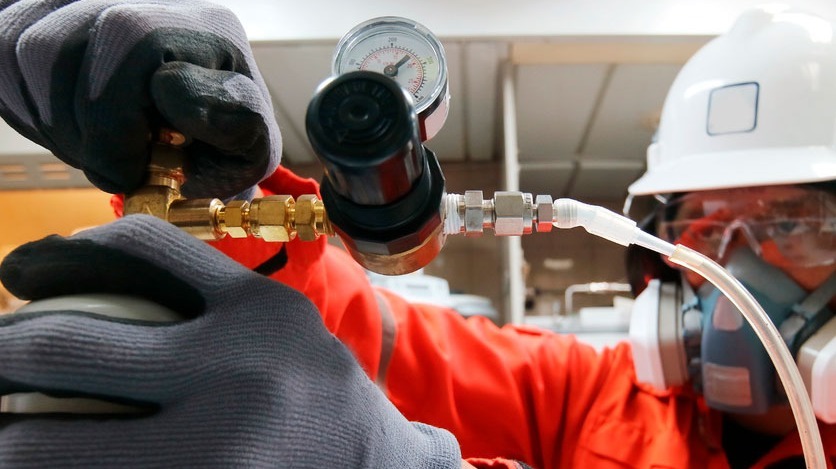
The equipment you use could also have an effect on the calibration gases. Some gases are reactive, and will interact with the materials they touch, especially brass.
A brass regulator may react with certain reactive or corrosive calibration gases, resulting in a lower concentration reaching the detector than the one in the cylinder. As this may cause inaccurate bump tests or calibrations, stainless steel regulators are often recommended instead. PTFE tubing and compatible gas bags from materials like Tedlar are also used to avoid reactions.
Gases at a low concentration will be especially vulnerable to reactions with improper equipment, so be especially alert when using a calibration gas at a low ppm.
Some gases even react to moisture. This means you should always double check whether your sensor is meant to be calibrated with dry or humidified gas, depending on the application and installation environment.
Shelf life and stock control
Calibration gases have an expiry date. A gas that has been stored too long produces inaccurate reference values, and leads to miscalibrated instruments. When vessels carry too much stock, to ensure they stay fully equipped, it is common for gas to expire before it is used.
This means good control over your gas inventory does not just mean having enough gas, but also not having too much of it.
The best course of action is to make an accurate overview of which instruments are on board, which gases they require, and how much is actually consumed per year. Do not stock up on too much, nor too little. Aim for the right amount.
Gas calibration mistakes are easy to miss
When your instruments are miscalibrated, it is often going to take a while before you notice. Alarms trigger too early, or too late, but you will likely assume they are correct. It is costly to wait until it is discovered by port state control.
The Bruusgaard Partner Program is our way of helping you stay on top of demanding gas calibration routines. You are supplied with the right amount of gas and equipment for your fleet, which comes with clear, stepwise instructions for how to use it.
Whether you rely on Bruusgaard or not, the importance of strict calibration routines can not be overstated. The health of both your crew and your operations is at stake.


 Customer support

 myBruusgaard